
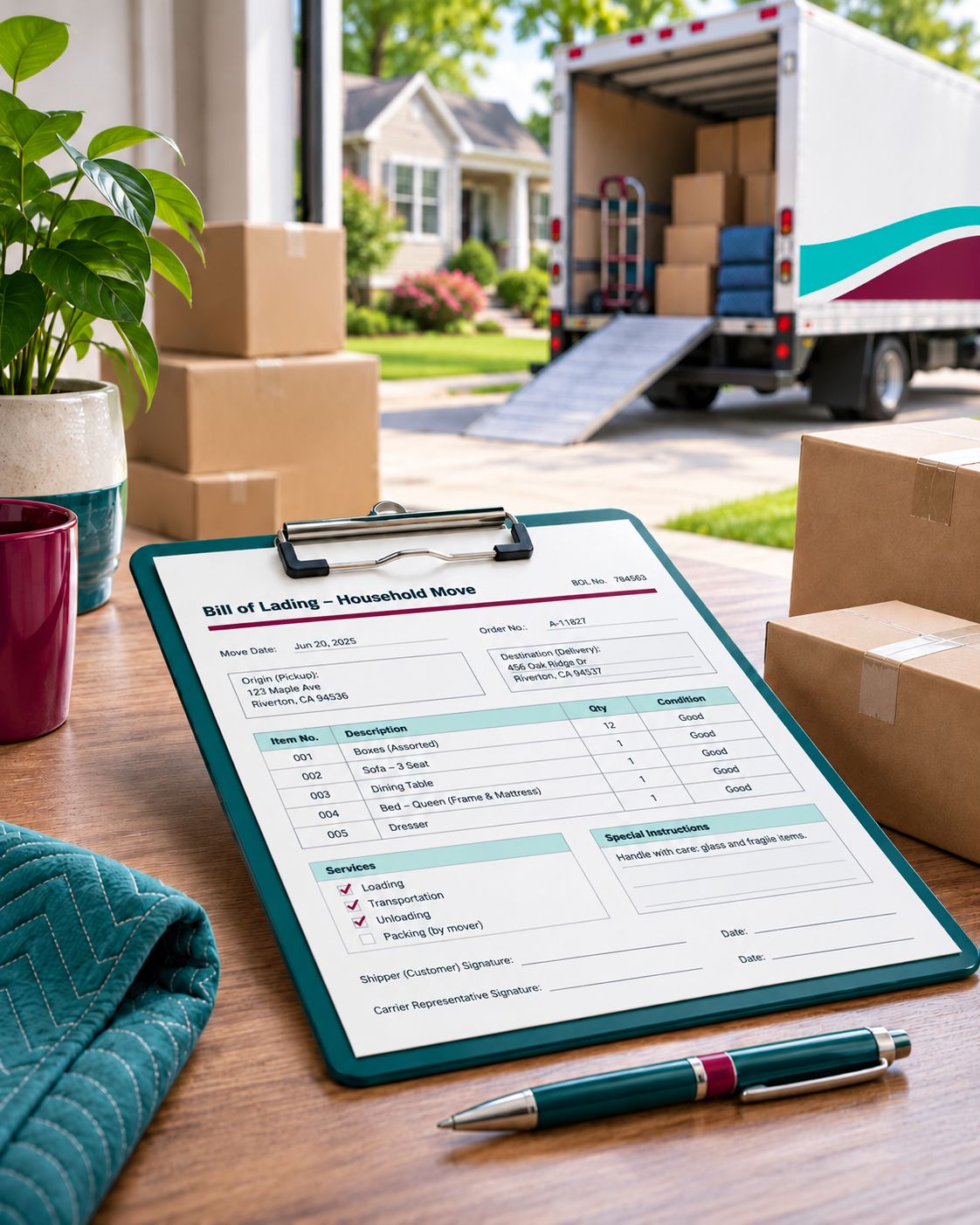
Moving Bill of Lading: What It Is and What to Check
If you are planning an interstate move, the bill of lading is one of the most important documents you will receive from your moving company.
A moving bill of lading is the contract between you and the carrier transporting your household goods. It identifies the shipment, describes the transportation services being provided, documents important terms of the move, and outlines your responsibilities and the mover’s responsibilities.
Unlike a moving estimate, which explains the expected cost of your move, the bill of lading governs the actual transportation of your shipment.
Before signing it, take time to make sure the information is correct and consistent with the estimate and other documents you have already received.
What Is a Moving Bill of Lading?
For an interstate household-goods move, the Federal Motor Carrier Safety Administration (FMCSA) requires the mover transporting the shipment to prepare a bill of lading.
The bill of lading serves as the transportation contract between the customer and the moving company.
It generally identifies:
the mover responsible for the shipment;
the customer and shipment;
agreed pickup and delivery information;
payment terms;
valuation or liability information;
services being provided;
applicable transportation charges; and
documents attached to or incorporated into the agreement.
The bill of lading should stay with the shipment while the mover is transporting your household goods.
You should also keep your own copy until your belongings have been delivered, all charges have been paid, and any claims have been resolved.
Is a Bill of Lading the Same as a Moving Estimate?
No.
A moving estimate and a bill of lading serve different purposes.
The estimate describes the expected charges for your move based on the information available when the estimate is prepared.
The bill of lading is the contract covering the transportation of the shipment.
For example, a binding estimate generally establishes an agreed price for the services and inventory included in the estimate, while a non-binding estimate provides an expected cost that may change based on the actual weight of the shipment and services performed.
The bill of lading incorporates the terms that apply when the shipment is actually transported.
If you are not sure how your estimate affects what you may ultimately pay, see our guide to binding vs. non-binding moving estimates before moving day.
Estimate vs. Bill of Lading
| Document | Main Purpose |
|---|---|
| Moving Estimate | Explains the expected or agreed moving charges |
| Order for Service | Confirms the services you requested |
| Bill of Lading | Serves as the transportation contract |
| Inventory | Records the items being moved and their condition |
These documents work together, which is why the information on them should be consistent.
When Should You Receive the Bill of Lading?
Do not wait until your belongings are already on the truck to begin reviewing the document.
FMCSA consumer guidance states that interstate movers must prepare a bill of lading for the shipment. The agency’s current Rights and Responsibilities guidance explains that the document should be issued before pickup, and the driver must provide a copy before or at the time your household goods are loaded.
This gives you an opportunity to review the terms before your shipment leaves the origin location.
Some information may not yet be final when the document is first prepared.
For example, with a shipment whose final charges depend on actual weight, the exact shipment weight cannot be entered until the shipment has been weighed. Certain legitimate charges may also depend on services that become necessary later.
That does not mean you should sign a blank document.
The bill of lading should contain the relevant information that is already known at the time you are asked to sign it.
What Should a Moving Bill of Lading Include?
For an interstate household-goods shipment, the bill of lading should contain detailed information about the mover, shipment, transportation terms, and payment.
Among the items you should expect to see are:
Mover identification
Check the legal or registered name of the carrier, its address, and its USDOT information.
This matters because the company named on the transportation documents should correspond to the carrier responsible for transporting your shipment.
If you are still unclear about the difference between a carrier and a broker, read our guide to moving brokers vs. carriers.
Customer information
Check your name, origin address, destination information, and contact details.
Small errors can create unnecessary confusion once the shipment is in transit.
Pickup and delivery information
Review the agreed pickup date or pickup period and the delivery date or delivery window.
Do not rely only on a verbal promise about when the shipment will arrive.
The written transportation documents should reflect the dates or periods you agreed to with the mover.
Payment terms
The document should explain the form of payment accepted and the payment terms that apply to the shipment.
Compare this information with your estimate.
If something is different from what you were previously told, ask for an explanation before signing.
Charges and services
Review the transportation services and other charges included in the shipment.
Depending on the move, these might include services such as:
unpacking;
storage in transit;
additional labor;
accessorial services required because of conditions at pickup or delivery.
The presence of an additional service does not automatically mean something is wrong. What matters is whether the service is legitimate, necessary, and properly documented.
Valuation and liability information
The bill of lading may also contain or incorporate information about the mover’s liability for loss or damage and the valuation option selected for the shipment.
Do not treat this section as boilerplate.
The valuation option you select can materially affect what the mover may be responsible for if an item is lost or damaged.
How Does the Moving Inventory Relate to the Bill of Lading?
The inventory is another important part of an interstate household-goods move.
The mover should prepare an inventory before or during loading that records the items being transported and notes their condition.
Before signing the inventory:
make sure your items are actually listed;
review any condition codes or damage notations;
question anything you believe is inaccurate;
make sure unusually valuable or important items are properly identified; and
retain a copy.
When the mover prepares the inventory, FMCSA treats the completed inventory as an integral part of the bill of lading.
That makes the inventory especially important if an item is later missing or damaged.
Do not sign an inventory simply because the loading process is busy.
Take enough time to review it.
What Should You Check Before Signing a Bill of Lading?
Use this simple checklist before accepting the document.
1. Check the moving company name
Make sure the carrier identified on the document is the company you expect to transport your household goods.
2. Verify your origin and destination information
Check addresses and contact details for errors.
3. Review pickup and delivery dates
Make sure the written dates or delivery spread match what you agreed to.
4. Compare the charges with your estimate
Look for unexpected services, unexplained charges, or major changes.
5. Review the valuation selection
Understand which liability option applies to your shipment before signing.
6. Review the inventory
Check that the shipment and condition notations are reasonably accurate.
7. Look for blank or incomplete sections
Some information, such as actual shipment weight, may legitimately remain incomplete until later.
But important information that is already known should not simply be left blank without explanation.
8. Ask about anything you do not understand
Do not sign because the crew is waiting or because the paperwork looks routine.
A legitimate moving document should be understandable enough for you to know what you are agreeing to.
What If the Bill of Lading Does Not Match Your Estimate?
Stop and ask about the difference before signing.
The estimate, order for service, bill of lading, and inventory are related documents. Important terms should not unexpectedly change from one document to another without an explanation.
For example, ask questions if you notice:
a different carrier name;
different pickup or delivery terms;
services you did not request;
unexplained charges;
different payment requirements; or
a valuation selection you did not choose.
There may be legitimate reasons for a change.
For example, you may have added household goods, requested an additional service, or encountered access conditions that were not known when the estimate was prepared.
Those changes should still be properly documented.
Red Flags to Watch for Before Your Shipment Leaves
A bill of lading should increase transparency, not create more uncertainty.
Be cautious if:
you are asked to sign a blank document;
the mover will not give you a copy;
the carrier name is different and no one can explain why;
important pickup or delivery information is missing;
payment terms suddenly differ from your estimate;
major new charges appear without explanation;
you are pressured to sign without reviewing the document; or
the mover discourages you from keeping copies of the paperwork.
One questionable detail does not automatically prove that a moving company is illegitimate.
But unexplained inconsistencies should be resolved before the shipment leaves.
Keep Your Moving Documents Together
During an interstate move, keep copies of your important documents somewhere you can access them without opening packed boxes.
That may include:
the written estimate;
order for service;
bill of lading;
shipment inventory;
valuation documents;
receipts;
written amendments;
payment records; and
communications relating to changes in the move.
FMCSA specifically recommends keeping the bill of lading until your goods are delivered, the charges are paid, and any claims are settled.
A simple digital folder with photos or scanned copies can also make your documents easier to access while traveling.
How Alma Moving Handles Interstate Moving Documentation
Alma Moving Inc. is an interstate household-goods carrier operating under USDOT 4085770 and MC 1555382.
For an interstate move, customers should receive and review the documents associated with their shipment, including the estimate and transportation paperwork, and should ask questions about anything they do not understand before signing.
Clear documentation is especially important when there are changes to the shipment, requested services, inventory, access conditions, or other details that may affect the move.
If you are still comparing moving companies, start with our guide on how to choose a moving company and verify the carrier’s federal operating information before booking.
You can also learn more about Alma Moving’s interstate moving services or request a moving estimate for a relocation from Florida.
Before Moving Day
The bill of lading is not just another piece of moving paperwork. It is the document that governs the transportation of your household goods.
Before signing, verify the mover, review the pickup and delivery terms, compare charges with your estimate, check the inventory, understand your valuation selection, and keep a copy of everything you sign.
A few extra minutes reviewing the paperwork before loading can prevent much more difficult questions after your shipment is already on the road.